4.4 Testing with Nuisance Parameters
1 Nuisance Parameters
Sometimes there are extra unknown parameters which we are not of direct interest. Like for
The issue is that
, . unkown. Consider test . If we denote , then nuisance parameter here can be or . . . Here are known, so they are not nuisance parameters.
2 UMPU Multivariate Tests
2.1 Multiparameter Exponential Families
Assume
The idea is to condition on
- Sufficiency reduction:
Let, here is the push-forward of . - Condition on
: - Conditional test: test
in parameter model .
If
, this family has MLR in . Even if , we still have gotten rid of .
2.2 UMPU for Multi Exponential Families
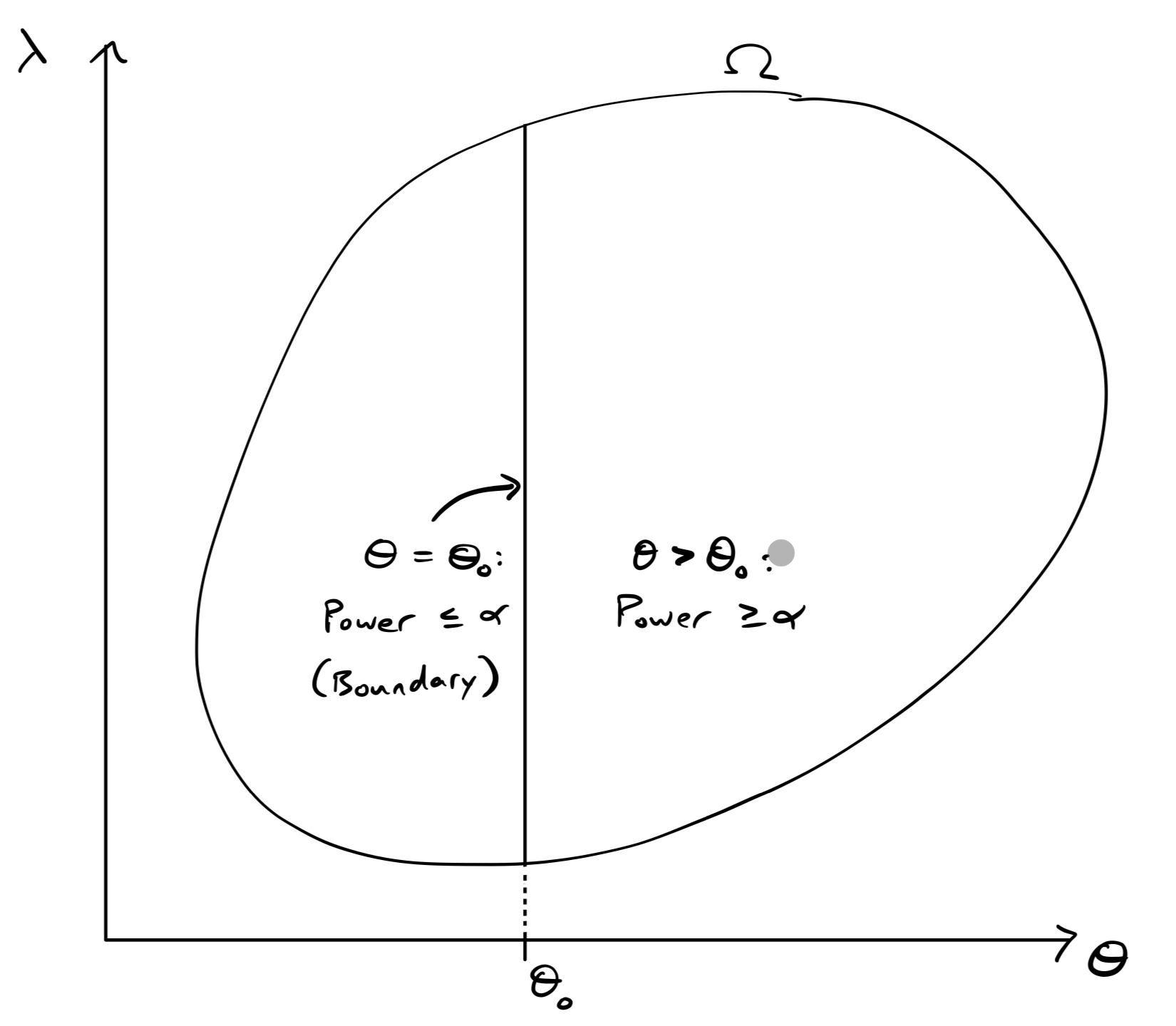
Sketch:
- Any unbiased test has
(by continuity of ). - If power
on boundary, . ( is complete sufficient on boundary submodel). optimal among all tests with conditional level (by reduction to univariate model).
Assume
#? (Need finishing)
If
Geometric picture for
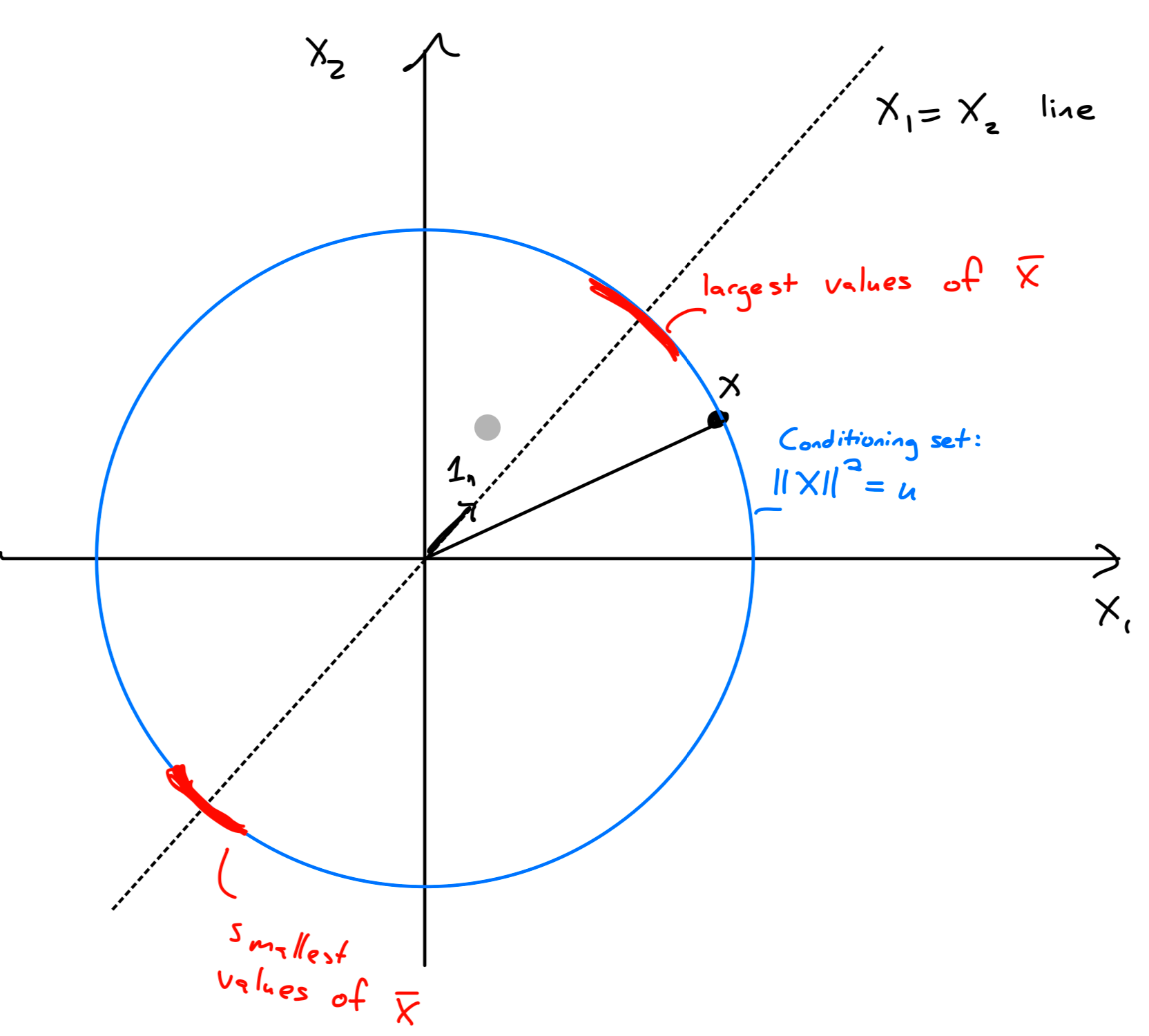
The above example rejects for
- Conditionally extreme
given . - (or equivalently,) Marginally extreme
independent of .
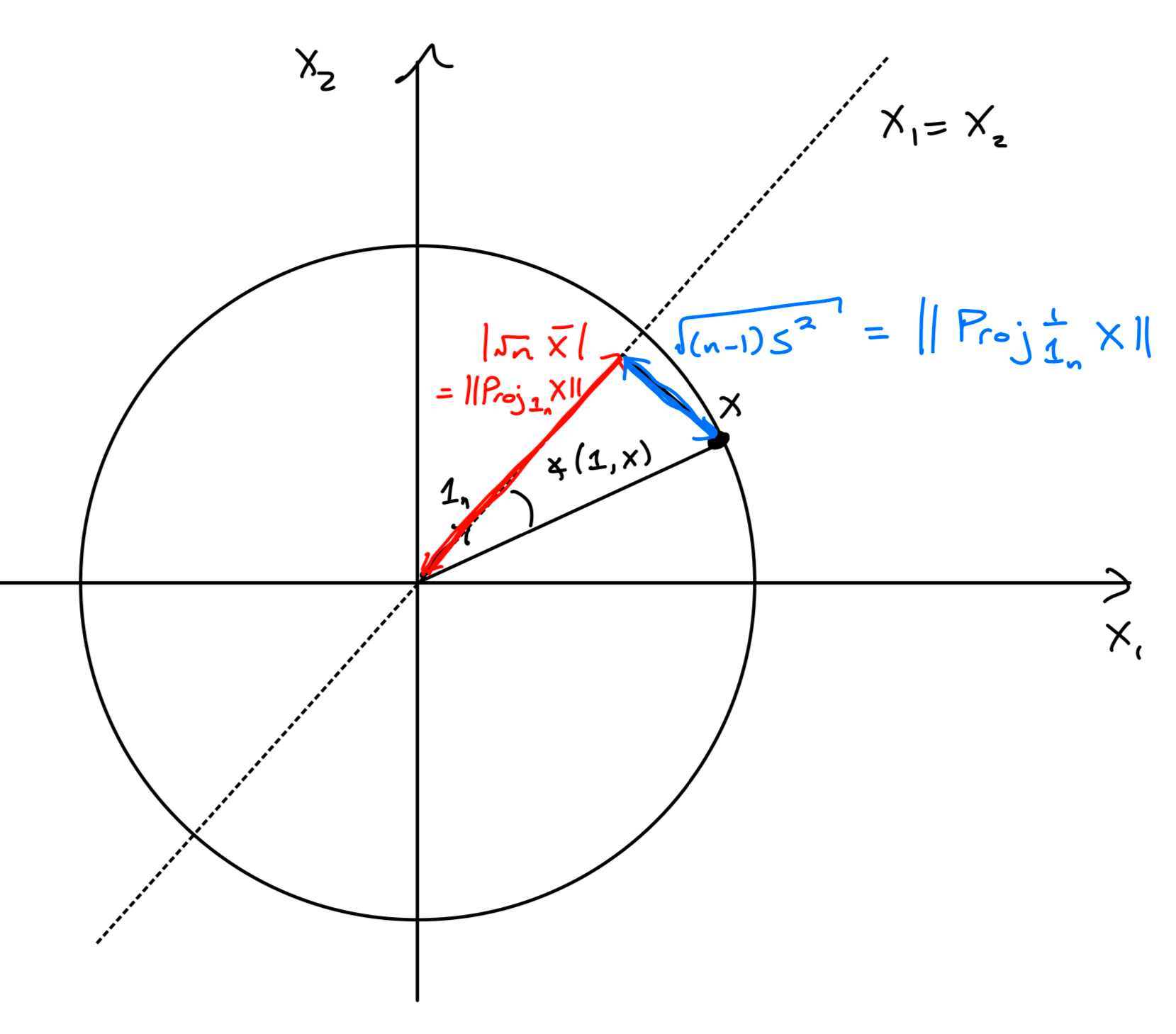
This is equivalent to reject for marginally extreme
Geometrically,
3 Permutation Test
Even if we don't get a UMPU test at the end, conditioning on null sufficient statistics still helps.
Let
Thus for any test statistic
Monte Carlo test:
In practice, we sample