Laplace location family: recall here we have shown if , is minimal sufficient. However, it's not complete. Denote as the sample median and sample mean of . Both of them are unbiased estimators for , so has expectation . But .
Uniform scale family: . Let . Then so Suppose s.t. we can differentiate to show that , a.s. So is complete.
1.2 Full-rank Exponential Families
It's hard to use definition to judge completeness, if can take on infinitely many values. However, for exponential family, we can easily verify completeness.
Full Rank, Curved
Assume is parameter exponential family in minimal form. If contains an open set, we say is full-rank; otherwise we say it is curved.
Theorem
If is full-rank, is complete sufficient.
Proof
Assume (this won't affect completeness), and , so , i.e. carnonical form. WLOG assume (otherwise we reparameterize).
Any measurable function can be decomposed as , where
Assume i.e.
By assumption, contains an open neighborhood that contains , on which both integrals are finite. Denote .
If , we define random variables with probability densities . (Here we perform a normalization) Then the MGF of is and likewise. So (*) implies that MGFs of are identical in neighborhood of . By uniqueness of MGF, we conclude , so .
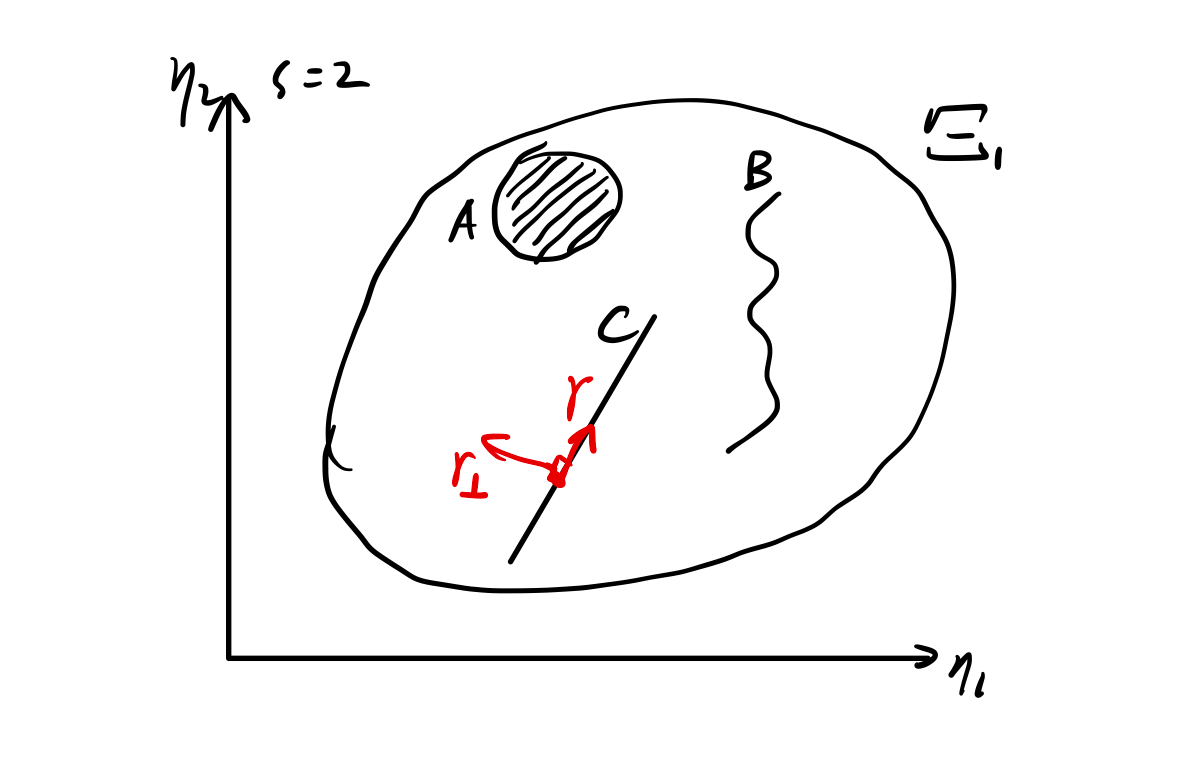
Now consider the diagram.
We've stated that are minimal. is minimal only when .
Now is full-rank exponential family because it contains an open set. is curved because it doesn't contain an open set. is full-rank only when (or we reparameterize it to make it 1 dimensional).
Assume is minimal sufficient, so any sufficient , we have . Now let (there is no under because of sufficiency), and let . Then the last equality is by tower property. So , so . This means we can calculate from , which is from , so is also minimal sufficient.
2 Ancillarity
We've discussed sufficient statistics as statistics carrying all information about . Now we want to discuss statistics carrying no information about .
Ancillary Statistic
is ancillary for if its distribution does not depend on .
Sufficiency Principle: if is sufficient, all inference should be conditional on .
Conditionality Principle: if is ancillary, all inference should be conditional on .
2.1 Basu's Theorem
Basu's Theorem is a useful tool to determine the independence of statistics.
We want to prove for any ,
Define , ( is ancillary, so no here), so
By completeness of , this implies . Then
Example: . . We want to show .
We first assume is known. Now is a one-parameter full-rank exponential family with complete sufficient statistic . Moreover, is ancillary, since and is known.
So applying Basu's Theorem, we have .
Since is arbitrarily picked, we have the conclusion hold for all .