We have defined probability in STAT 201A note. However for a different course with (possibly) different notations, we will derive again.
1 What is Probability?
Frequentist answer: a relative frequency over many repeats of the same experiment.
Bayesian answer: a degree of belief that something is true/will happen.
Probability
Mathematical probability is a function mapping some subsets of a sample space to , satisfying
,
,
(disjoint additivity)
2 Measure and Integrals
2.1 Measure
Given a set , a measure is a certain kind of function mapping "nice enough" subsets to non-negative numbers .
Examples of Measure
Counting measure: is countable (like ), use to define the number of points in .
Lebesgue measure: , .
Gaussian measure: ,
Generally, the domain of a measure is just a collection of "nice" subsets . should satisfy certain closure properties.
First we need definition of algebra. It's not important. See definition here.
Measure
Given measurable space , a measure is a map with disjoint additivity and . is probability measure if .
2.2 Integral
Integral
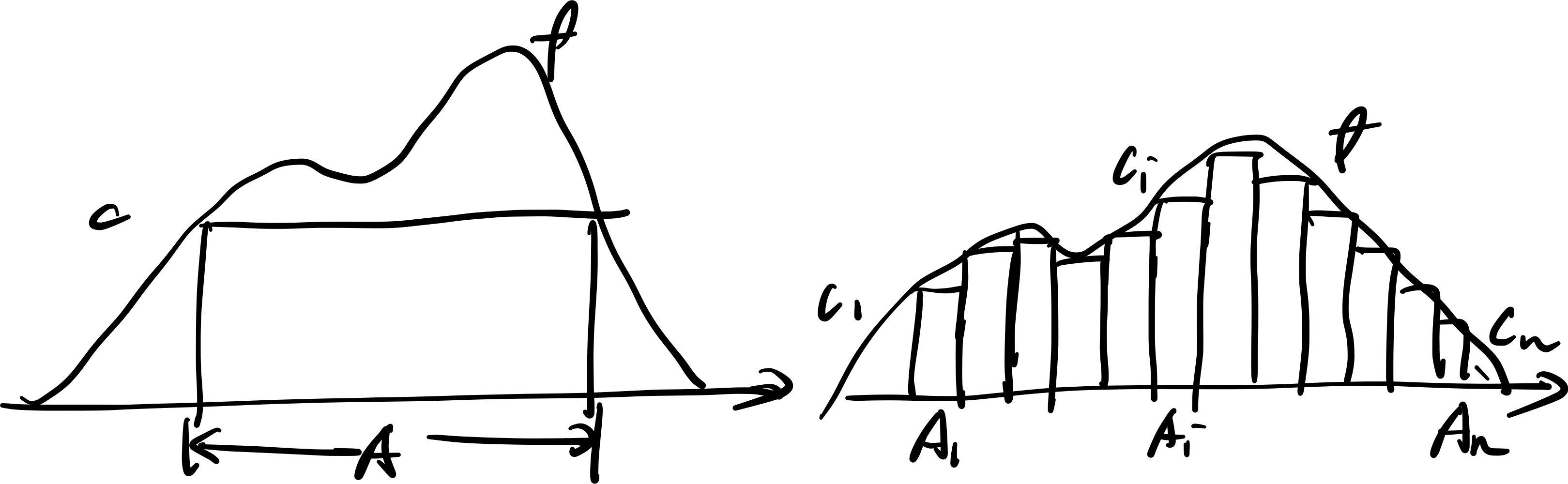
An integral w.r.t puts weight on . Define We can extend to other functions by linearity
and limits
Example
For counting measure, .
For Lebesgue measure, .
For Gaussian measure,
3 Densities
A measure is absolutely continuous w.r.t , if whenever . Denote as or dominates .
If , then define density function s.t. and by extension . Density function is also called Radon-Nikodym derivative of w.r.t , and is sometimes written as .
If we don't specify , it is the Lebesgue measure. I.e., is absolutely continuous in default means .
If is probability, and is Lebesgue measure, then is called probability density function (p.d.f);
Elif is counting measure, is called probability mass function (p.m.f).
4 Probability Spaces, Random Variables
Denote the outcome space . To evaluate whatever , it is convenient to start with abstract outcome .
represents everything that "happens".
Quantities of interest are functions of . (i.e., )
Probability Space
We have a probability space.
is called outcome.
is called event.
is called probability of event .
Function is called random variable.
We say has distribution (defined as ) if .
is the push-forward of through function : .
Applied more generally, if is a measure on , leads to new measure . ( denotes the preimage)