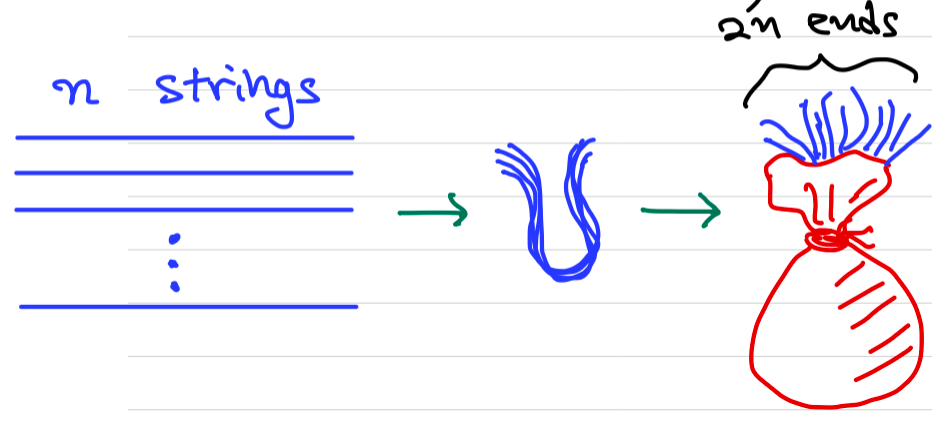
Suppose you tie two free ends u.a.r and continue until no more free ends remain. What is the expected number of loops formed?
Denote as number of loops formed. Suppose currently there are open strings. Then we have to tie times. For the th time, if a new loop is formed, then denote . Else . Then so
Since there are free ends, so
1 Boole's Inequality
By disjoint additivity we can compute
Actually we have the general Inclusion-Exclusion Principle: where , which can be proved by induction and definition. However we can have a neater result when it comes to inequality:
Theorem (Union Bound, Boole's Inequality)
are a collection of events on a probability space . Then
This can be proved by induction on and (1.1), so is omitted.
2 Cauchy-Schwarz Inequality
Theorem (Cauchy-Schwarz Inequality)
Let be two RVs on the same probability space. Then i.e.
Proof
For constants ,
Let , then
Similarly, the other side can be proved by .
3 Concentration Inequalities
We often want to estimate the tail, i.e. or . This is important for proving convergence results, bounding failure probabilities, or probabilistic bounds on runtimes.
3.1 Markov's Inequality
Theorem (Markov's Inequality)
Let be a non-negative RV with . Then for any constant ,
Proof
Lemma
X is a non-negative RV, then , .
Recall indicator RV: for , , so .
Proof of Lemma
.
If , . And non-negative, so . Then result holds.
If , . Also holds.
By the lemma, , . Take expectation:
Theorem (Generalized Markov's Inequality)
Let be an arbitrary RV. Then for all constants ,
Proof
Similar argument as above, applied to .
3.2 Chebyshev's Inequality
Theorem (Chebyshev's Inequality)
For all RVs with and for all constants ,
Proof
Since ,
Here we applied Markov's Inequality.
3.3 Chernoff Inequalities
Theorem (Chernoff Inequalities)
A one-parameter family of bounds derived as follows:
,
,
Proof
For case, by Markov's inequality
(Check definition of MGF) Since LHS is irrelevant of , we can take minimal to . Similar for .
Example
If , then .
For , . Take derivative to find the minimum point
Let it be , then . Plug in Chernoff Inequalities, we have
For , this yields . This is much stronger than:
Markov's inequality: ,
Chebyshev's inequality:
3.4 Hoeffding's Inequality
This inequality is specific for bounded RVs.
Theorem (Hoeffding's Inequality)
Let be independent RVs with , and for some constants . Let , then ,
Equivalently,
Hoeffding's bound only depends on the range of , not its distribution over . Using more information about can lead to a sharper bound, like Chernoff.
Proof
First, recall MGF for normal distribution. Let , with p.d.f . Then ,
Sub-Gaussian
A RV with is said to be sub-Gaussian with variance proxy, if
Lemma1
Let be a sub-Gaussian RV with and variance proxy . Then ,
Proof of Lemma 1
By Chernoff inequalities, , where the second "" is derived from lemma assumption. We know by taking derivative, is minimized at . Plug it in:
Similarly, ,
So
Lemma2 (Hoeffding's Lemma)
Let be a RV s.t. and for some constants . Then i.e. sub-Gaussian with variance proxy .
Proof of Lemma 2
Let and (). Then ()
Define a probability measure (). Then the last "" holds because Then . Since is monotonically increasing, .
Given the above two lemmas, we can prove Hoeffding's inequality.
First, since
("" by lemma 2) so is sub-Gaussian with variance proxy .
Next, let and apply lemma 1, we complete the proof.