We've introduced common concepts about Markov chain.
Consider a state MC. The transition matrix is , where . Then
Suppose . Then
Suppose , , so , so
In fact, is the unique stationary distribution of the Markov Chain. ()
In general, every finite-state Markov Chain has a stationary distribution and by irreducibility, is unique.
Question: under what condition is ?
Period
The period of a state is defined as
For example above, .
Periodic / Aperiodic
A state is periodic / aperiodic, if .
Claim
If , then .
Suppose a class of period . Then there exists a partition .
Theorem
Let be a class in a finite-state Markov Chain with period . Then can be partitioned into subsets s.t. all transitions from go to .
Let be an irreducible, positive recurrent MC on state space and stationary distribution . Suppose be a function s.t. . Then for any initial distribution for ,
3 First Passage Time
First Passage time
For , .
Fundamental Matrix of Irreducible MC
.
is well defined.
If the MC is aperiodic, then .
Mean First Pasage Time
For an irreducible finite Markov Chain with the fundamental matrix and the unique stationary distribution ,
Suppose a finite MC is not irreducible (i.e., has more than one SCC) restricted to each terminal SCC is a valid transition matrix. Then there exists a stationary distribution for each terminal SCC.
4 Reversible MC
Theorem
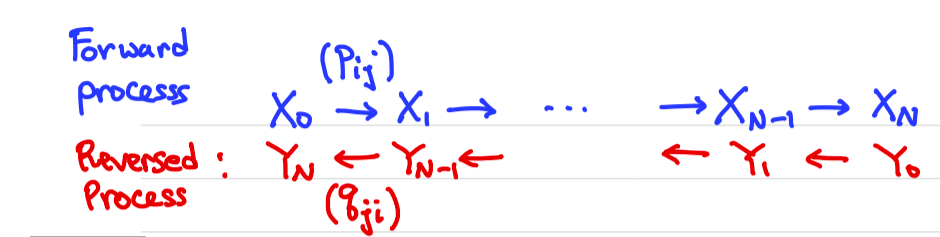
Let be an irreducible positive recurrent MC with transition matrix and unique stationary distribution . Further, suppose . Then the reversed process is a MC with transition matrix , where .
Proof
Reversibility
The chain is said to be reversible if , . That is, detailed balance
Theorem
Let be an irreducible Markov Chain with transition matrix and suppose a distribution s.t. , . Then is a stationary distribution of the chain and is reversible in equilibrium.
Proof
Since then is a stationary distribution. Reversibility of follows from definition.